Structures we supply
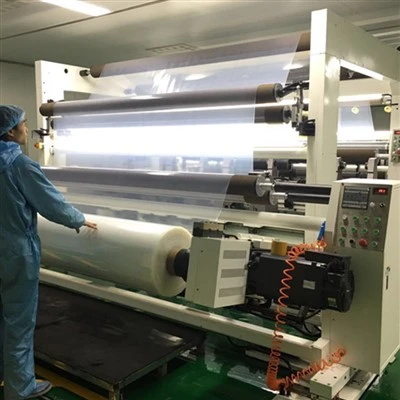
Our forming films are coextruded in 7, 9 or 11 layers, with standard, medium and high barrier options. The main structures are PA/PE, PE/EVOH/PE, PA/EVOH/PE and PA/EVOH/PP. PA (nylon) gives toughness, puncture resistance and forming depth; EVOH adds an oxygen barrier; PE or PP forms the seal layer. Films can be printed, coloured and produced in widths up to 3,500 mm.
|
Application |
Structure we usually recommend |
Why |
|
Frozen products |
PA/PE |
Common starting point in our frozen-food orders; barrier needs vary by product |
|
Chilled products needing stronger oxygen protection |
PA/EVOH/PE |
EVOH adds oxygen barrier where the product and shelf life call for it |
|
Boiling at 100 °C (about 30 min) |
Suitable boiling-grade PA/PE |
A grade we commonly suggest for this process before a packing trial |
|
Retort at 121 °C |
Retort-grade PA/PP or PA/EVOH/PP |
Heat-resistant structure and seal layer selected for the full retort cycle |
PA/PE is the most requested forming film in our business. We commonly recommend it as a starting point for frozen products and general applications. Where the product needs stronger oxygen protection, we consider an EVOH-containing structure alongside the storage conditions and intended shelf life.
Barrier selection depends on the product, intended shelf life and storage conditions. Our guide Choosing EVOH Film for Food Packaging explains when an EVOH structure may be worth considering.
Matching thickness to pocket depth
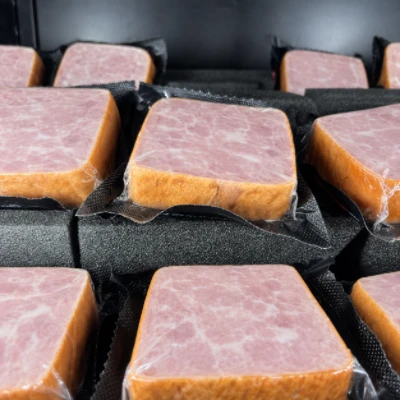
Forming film becomes thinner as it stretches into the pocket. In our supply experience, a pocket about 3 cm deep for meat, sausage or similar packs is often a starting point for sampling 150–200 μm film. Across applications, our forming films typically range from 150 to 400 μm.
A deeper pocket, sharp product edges or heavier contents may call for a different thickness or structure. Our forming film thickness guide gives further reference ranges and explains when we would adjust the initial recommendation.
The bottom web and lid also need to work together. Our lidding film vs forming film guide explains their different roles and the sealing requirements to consider.

Common forming problems and their usual causes
If film tears during forming, corners look weak or packs break in transport, compare the problem with the last satisfactory run. Film structure and thickness matter, but heating, forming conditions and handling also need checking.
Films with the same structure name and thickness can perform differently because their formulations and layer ratios differ. Our guide to thermoforming film tears and thin corners explains the film checks and the information that helps us suggest alternative samples.

Boiling or retort: PA/PE or PA/PP?
For heat-treated packs, tell us both the processing temperature and holding time. These help us select an appropriate seal layer and film grade.
For boiling around 100 °C for about 30 minutes, we commonly recommend a suitable PA/PE grade for sampling. For retort around 121 °C, we normally consider retort-grade PA/PP or PA/EVOH/PP. The full structure, including the lid, needs to suit the process.
Our guide to thermoforming film for boiling and retort covers these choices in more detail.
Example test data
The table below shows test results for one of our standard forming films, a 7-layer PA/PE sample at 150 μm. Because our films are made to order, these values are a reference rather than a specification for every structure.
|
Property |
Result |
Test method |
|
Tensile result (TD / MD) |
75 / 72 N/15 mm |
GB/T 1040.3 |
|
Heat-seal strength |
54 N/15 mm (140 °C, 1 s, 0.2 MPa) |
QB/T 2358 |
|
Oxygen transmission (OTR) |
22.5 cm³/(m²·24 h·0.1 MPa) |
GB/T 1038 |
|
Water vapour transmission (WVTR) |
3.2 g/(m²·24 h), 38 °C / 90% RH |
GB/T 1037 |
|
Peel strength |
10.5 N |
GB/T 2790 |
|
Coefficient of friction (static / dynamic) |
0.27 / 0.22 |
GB 10006 |
Additional sample performance data
The following results are from a separate 150 μm PA/PE forming film sample. They describe the mechanical and barrier properties of that sample and provide a reference for comparing film options.
|
Test item |
Result |
|
Tensile force (MD / TD) |
53.1 / 42.8 N |
|
Elongation at break (MD / TD) |
394% / 442% |
|
Heat-seal strength |
32.5 N/15 mm |
|
Interlayer peel strength |
No delamination |
|
Haze |
13.2% |
|
Water vapour transmission |
4.1 g/(m²·24 h) |
|
Oxygen transmission |
35.2 cm³/(m²·24 h·0.1 MPa) |
These data sets relate to different 150 μm PA/PE samples. Read each value with its corresponding formulation and test conditions; the results are not interchangeable specifications. When discussing sample options, let us know which properties matter most for your product and packaging process.
Choosing samples for your packaging line
We use your application details and our supply experience to suggest a film structure and thickness. We then provide samples for testing on your packaging line. Your trial confirms how the film forms and seals with your product and whether the finished pack meets your handling and storage needs. Free samples are available.
What to send for sample selection
The food product, intended shelf life and storage conditions: chilled, frozen or ambient.
Any boiling or retort process, including temperature and holding time.
Approximate pocket depth and pack size, or a photo of the finished pack. An existing film specification is helpful if available.
Packaging machine model if known, film width, roll diameter and core size.
Does the film need printing or colour?
Expected quantity.
Send these details to Fuya so we can recommend sample options. After testing, share the forming and sealing results and any pack failures; we can use that feedback to review the proposed specification. Explore our thermoforming film range.