Multilayer coextrusion and the role of each layer
Coextrusion combines separate resin streams into a multilayer material. EVOH supplies the gas barrier, while supporting layers provide sealing and mechanical functions. Tie resins connect materials where additional interlayer adhesion is needed.
An illustrative sequence is PE / tie / EVOH / tie / PE. This is a structural example, not a complete production recipe. The resin grades, layer proportions and required properties must be selected for the intended pack. Descriptions such as PA/EVOH/PE may be shorthand and may omit tie or other functional layers.
Blown film coextrusion
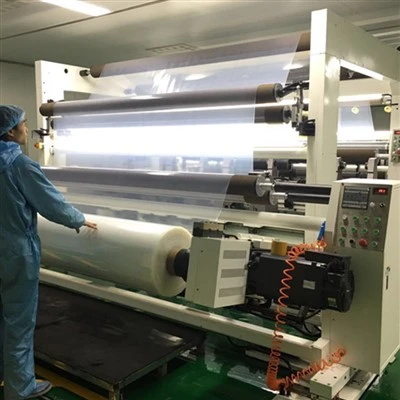
Blown film coextrusion forms a tubular film through an annular die. The tube is expanded, cooled and collected as film for subsequent use or conversion. The line design and operating conditions affect the resulting film, so air-cooled and water-cooled processes should not be assumed to produce identical results.
Blown film production offers flexibility when different film widths and thicknesses are needed. Buyers can compare roll quality and how the proposed film runs on their line.
Cast film coextrusion
Cast film coextrusion forms a flat multilayer web through a flat die and cools it on a chill roll. This route is used for barrier films, including materials intended for forming applications. Efficient cooling can support the production of thicker, transparent films, and high-output lines can be economical for larger batches.
Compare routes against the project requirements, including thickness consistency, optics, forming behavior and order size. Neither process is universally better.
Lamination of barrier materials
Lamination combines an existing barrier film with another web to create the required finished material. A project may need a printed outer web, a different seal surface or additional mechanical properties. The EVOH-containing film can therefore be an input to a laminate rather than the complete packaging material.
In dry lamination, adhesive is applied to a web and dried before the webs are joined. Adhesive selection, drying and curing must suit the materials and end use. In extrusion lamination, a molten polymer layer joins substrates. The chosen bonding system and conditions should be checked for adhesion and compatibility. Lamination adds to an existing web, while coextrusion creates a multilayer web from melt streams.
Thermoforming of suitable EVOH structures
Thermoforming heats and shapes an appropriate film or sheet into a cavity. The structure must tolerate the required deformation while retaining the functions needed by the finished package. Specialized EVOH grades are available for thermoformed films, cups and trays.
During a customer trial, check whether the film forms the required pocket, whether corners or sidewalls appear weak, and whether it seals reliably with the intended lid. Approximate pocket depth, pack dimensions and photos are enough to start discussing samples. Detailed mould drawings are not a prerequisite.
|
Stage |
Main decision |
Buyer check |
|
Blown coextrusion |
Does the structure and line suit the required film? |
Roll consistency and performance in the intended conversion |
|
Cast coextrusion |
Does the route meet the film and order requirements? |
Thickness profile, appearance and forming or converting trial |
|
Lamination |
Which additional web or surface is needed? |
Bond performance and compatibility with the end use |
|
Thermoforming |
Can the material form the specified cavity? |
Formed shape, weak corners and sealing with the intended lid |
Controls during film manufacturing
At the film factory, resin moisture, melt temperature and residence time are controlled according to the selected EVOH grade. These are film-production settings, separate from the forming and sealing settings on a food-packaging line.
If bubbles, gels or layer separation are found, the film producer can investigate the material and production conditions. For buyers, a film sample, batch details and photos of the defect are useful starting information.
|
Issue in the supplied film |
Checks by the film producer |
|
Bubbles or voids |
Resin moisture condition, handling and processing temperature |
|
Gels or visible specks |
Material history, mixing, temperature and residence time |
|
Separation between layers |
Layer sequence, tie or adhesive selection and bond results |
Several factors can cause a similar defect. The film producer can use these checks to investigate the cause, while the customer reports what happened during packing.
Information to include in a film enquiry
Tell us the product, whether the film will be formed or used as a lid, the approximate dimensions, equipment details and expected quantity. Include the current film specification or a sample if available. We can suggest alternatives for a trial on your line, focusing on forming, sealing and any problem you want to resolve. Discuss a coextruded EVOH film structure with Fuya.