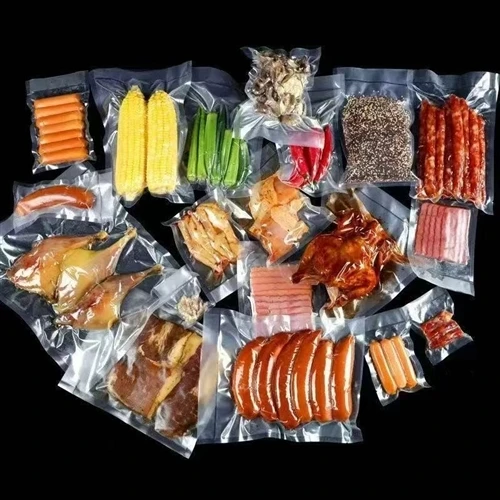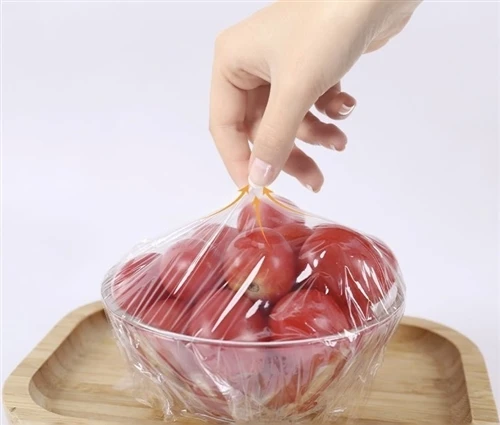


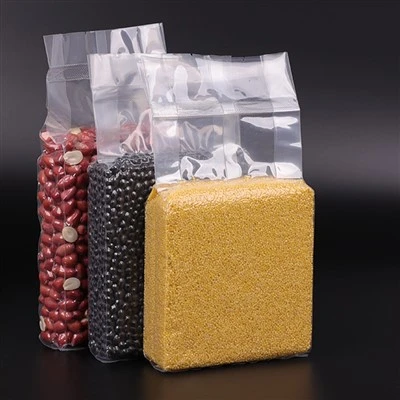
Two bag formats
|
Three-side seal vacuum bag |
Tubular vacuum bag |
|
|
Construction |
Flat pre-made bag, sealed on three sides with one open end |
Made from tubular film with a back or centre seal; both ends sealed, forming a tube, pillow or brick shape |
|
Typical machines |
Premade-pouch (bag-feeding) packing machines and external (nozzle) vacuum sealers |
Double-chamber and continuous vacuum machines |
|
Best suited to |
Small, flat, sliced or block products; retail single packs with a good display face |
Medium to large packs, granules and powders, long or whole products; storage, transport and efficient automatic lines |
Who uses three-side seal vacuum bags
Meat and cooked-food processors: steaks, chicken breast, chicken feet, duck neck, braised beef, cured pork, sausages, bacon and sliced ham.
Seafood processors: fish fillets, dried fish, shrimp meat, sea cucumber, abalone, shellfish and squid.
Soy, rice and noodle products: dried tofu, tofu skin, rice cakes, zongzi and small rice or grain bricks.
Nuts, coffee and tea: coffee beans, nuts, seeds and tea.
Pet food: freeze-dried treats, jerky strips and pet snacks.
Pharmaceutical and industrial users: herbal materials, electronic components, hardware and precision parts that need moisture and rust protection.

Who uses tubular vacuum bags
- Rice and grain mills: rice, mixed grains, beans, flour and rice bricks.
- Pet food and feed producers: pet food, cat litter and animal feed.
- Coffee and nut processors: coffee beans, bulk nuts and roasted seeds.
- Meat and seafood processors: whole chickens and ducks, ham, sausages, cured pork, dried fish and bulk seafood packs.
- Vegetable and pickle processors: sweet corn, bamboo shoots, mushrooms and pickled vegetables.
- Home textile and storage brands: compression bags for quilts, duvets, blankets and garments.
- Industrial users: chemical powders, moisture-sensitive electronics and hardware.
Quilt and blanket compression bags
Compression bags for quilts and blankets are tubular vacuum bags. Removing the air shrinks a bulky quilt to a fraction of its size for home storage, retail or shipping. The right thickness depends on how heavy the item is and how long it stays compressed:
|
Use |
Bag thickness |
Why |
|
Thin and summer quilts, short-term storage |
70–90 μm |
Low cost; suits light items that are not compressed for long |
|
Standard and winter quilts, home storage |
100–120 μm |
The most common choice, balancing strength, cost and evacuation |
|
Down and thick quilts, long-term compression |
120–150 μm |
Strong rebound force, so the bag must resist rubbing and folding |
|
E-commerce shipping, repeated use, industrial compression |
150–180 μm |
Better resistance to handling and crushing; too thick can make evacuation and sealing harder |
|
Heavy-duty long-term warehousing |
180–200 μm and above |
Mainly industrial; rarely needed for home use |

Structures we supply
|
Bag format |
Structure |
Notes |
|
Three-side seal |
PA/PE, 7 or 9 layers |
Produced on downward water-cooled blown film lines; the most common choice for general vacuum packing |
|
Three-side seal |
PA/PP |
For retort sterilization at 121 °C |
|
Tubular |
PE/PA/PE (for example PE/PE/tie/PA/tie/PE/PE) |
PE on both sides of the nylon core; suited to tubular bag making |
Heat treatment decides the seal layer. For boiling at 100 °C for about 30 minutes, PA/PE is sufficient. For retort sterilization at 121 °C, use PA/PP with an inner layer rated for that temperature. Where a defined oxygen barrier or a long chilled shelf life is required, EVOH vacuum bags are also available.
Choosing thickness for bone-in products
Bones and sharp edges are the most common reason a vacuum bag is punctured, because the vacuum pulls the film tight against every point of the product. As a guide from our orders:
|
Product |
Recommended bag thickness |
Note |
|
Ordinary bone-in meat |
120–150 μm |
Typical cuts with moderate bone |
|
Sharp bones or large pieces |
150–200 μm |
Sharp edges, large cuts or heavy packs |
Thickness is not the only factor. Nylon content gives puncture resistance, so a well-formulated film can outperform a thicker one with less nylon. Confirm the final choice with a packing trial on your own product.

Why vacuum bags leak or break
Leaks and breakage rarely have a single cause. Material, sealing, equipment, film quality, operation and transport can all play a part, so each needs to be checked in turn. The location of the failure is the best starting point:
|
Where it fails |
Common causes |
|
Leak at the seal |
Wrong seal temperature, pressure or time; product or grease trapped in the seal; moisture; wrinkles in the seal; insufficient cooling |
|
Hole in the bag face |
Puncture by bones or sharp corners; film with too little puncture resistance; evacuating too fast; crushing in transport |
|
Split at edges or corners |
Stress concentration at three-side seal corners; overfilling; unsuitable bag type; seal margin too narrow |
|
Leak at the back seal |
Poor overlap on a tubular bag back seal; film tracking off line; uneven temperature; thickness variation at the back seal |
|
Breakage after freezing |
Poor cold resistance; a PE layer that becomes brittle; drops after freezing |
|
Leak after retort |
Inner layer not rated for retort temperature, such as a non-RCPP seal layer; insufficient heat resistance; poorly controlled counter-pressure during cooling |
|
Tear at the seal root |
Seal too brittle; over-sealing; seal margin too narrow; product pressing against the seal |
Independent test results: PE/PA/PE film for tubular bags
A 7-layer PE/PE/tie/PA/tie/PE/PE co-extruded nylon film used for tubular vacuum bags was tested in July 2026 by Zhejiang Fangyuan Test Group, which also operates the National Center of Quality Inspection for Prepackaged Foods (Zhejiang). Testing covered 24 items, including food-contact requirements under China's current national food safety standards GB 4806.7-2023 and GB 4806.13-2023. All items passed.
|
Test item |
Requirement |
Result |
|
Dart impact |
≥ 80 g |
> 1500 g |
|
Tensile force (MD / TD) |
≥ 18 / ≥ 15 N |
44.5 / 43.7 N |
|
Elongation at break (MD / TD) |
≥ 200% |
452% / 465% |
|
Heat-seal strength (MD / TD) |
≥ 10 N/15 mm |
29.8 / 28.4 N/15 mm |
|
Right-angle tear (MD / TD) |
≥ 4 N |
9.2 / 8.7 N |
|
Interlayer peel strength |
≥ 4.0 N/15 mm |
Could not be separated |
|
Oxygen transmission (GB/T 1038.1-2022) |
≤ 220 cm³/(m²·24 h·0.1 MPa) |
40.6 |
|
Water vapour transmission (GB/T 1037-2021) |
≤ 15 g/(m²·24 h) |
3.48 |
|
Overall migration (10% ethanol / 4% acetic acid / 95% ethanol) |
≤ 10 mg/dm² |
1.2 / 1.3 / 2.1 |
|
Primary aromatic amines |
Not detectable |
Not detected |
|
Caprolactam specific migration (10% ethanol) |
≤ 15 mg/kg |
1.1 |
|
Coliforms and Salmonella |
Not detectable |
Not detected |
The dart impact result stands out: more than 1,500 g against a requirement of 80 g. That reserve of impact and puncture resistance is what protects a vacuum pack from bones, corners and rough handling. As with any test data, values apply to the tested sample; thickness, structure and formulation are adjusted for each application. The full report is available on request.
What we ask before quoting
- What product will be packed?
- What bag size do you need?
- How will the bags be used: which vacuum machine, and will they be boiled or retorted?
- How will the packed product be stored: chilled, frozen or at room temperature?
- Do you need three-side seal bags or tubular bags?
With these answers we can recommend the format, structure and thickness, and prepare samples for a packing trial. See our vacuum bags or send your packaging details to Fuya.